The TikTok Skincare Problem: Why Adult Products Don’t Belong on Kids’ Skin

Updated: May 28

The TikTok Skincare Problem: Why Adult Products Don’t Belong on Kids’ Skin
I want to talk about something that’s becoming impossible to ignore.
More and more children are asking for skincare products not because their skin needs them, but because they’ve seen them online. A routine goes viral. A “before and after” clip pops up. A child watches someone apply ten products in under a minute — and suddenly, they want the same thing.
As a dermatologist, this worries me. Not because skincare is bad, but because context is missing.
Children’s skin is not adult skin in a smaller body. It’s thinner, more permeable, and far more reactive. What an adult’s skin may tolerate — or even benefit from — can quietly damage a child’s skin barrier when used too early.
What social media rarely explains is that many of the products trending online are designed to correct problems that don’t exist in childhood. Acids are meant to resurface aging skin. Retinoids are designed to regulate adult cell turnover. Strong exfoliants intended to unclog pores affected by years of oil buildup.
When these products are applied to young skin, the result isn’t prevention — it’s irritation.
I often hear parents say, “But it says gentle,” or “It’s clean,” or “Everyone is using it.” Those labels are comforting, but they’re not the same as appropriate.
Even well-formulated products can be wrong for a child’s skin simply because the skin isn’t ready for that level of stimulation.
What usually happens next is subtle at first. Skin becomes dry, tight, or slightly red. A child may complain that their face feels itchy or stings when water touches it. Parents assume the skin is “sensitive” — when in reality, the barrier has been disrupted.
Over time, repeated exposure to adult products can create a pattern of inflammation that lingers into the teen years. Acne becomes harder to manage. Sensitivity becomes chronic. The skin learns to overreact.
And there’s another layer to this conversation that matters deeply to me.
Skincare content online is rarely neutral. It often frames skin as something that needs fixing, improving, correcting, or perfecting. When children absorb that message too early, it can shape how they see themselves long before they’ve had a chance to simply be comfortable in their skin.
I believe skincare education for kids should never begin with fear of flaws.
It should begin with respect for the body.
If a child enjoys watching skincare content, that curiosity doesn’t need to be shut down.
It needs guidance. This is an opportunity to teach discernment — to explain that some things are designed for adult skin, just like certain foods or supplements are for adults, not children.
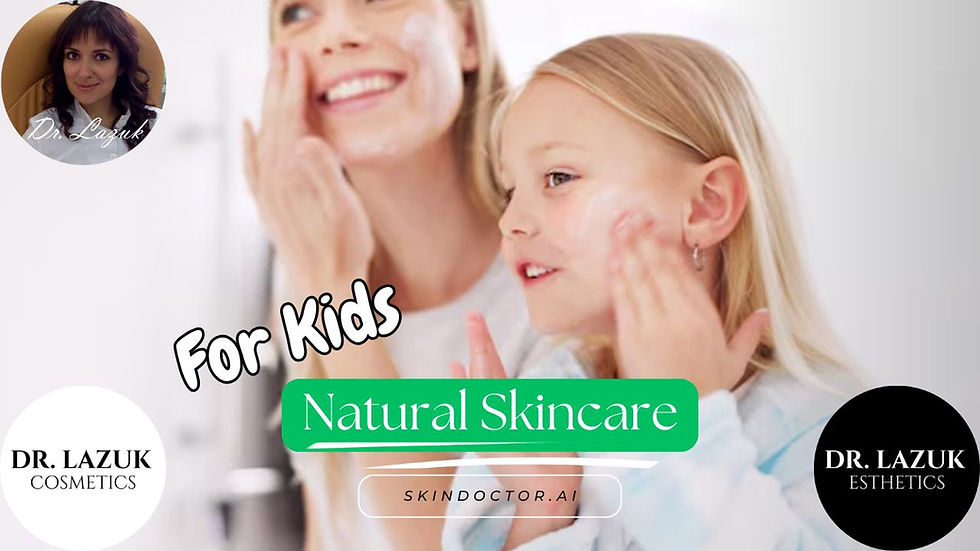
The safest approach for kids is still the simplest one. A gentle cleanser when needed. A basic moisturizer if skin feels dry. Sunscreen when exposed to the sun. No acids. No retinoids. No scrubs. No devices. No pressure to keep up.
When acne or other skin concerns appear later on, especially during adolescence, that’s the moment to seek professional advice — not viral routines.
Healthy skin habits should support confidence, not create anxiety. They should teach care, not correction.
If your child is asking for products they’ve seen online, you’re not failing by saying no. You’re protecting their skin — and their sense of self.
And that, truly, is the most important skincare lesson of all.
May your child grow up with skin that feels strong, supported, and respected.
~ Dr. Lazuk
CEO & Co-Founder
Dr. Lazuk Esthetics® Cosmetics®
Entertainment-only medical disclaimer
This content is for educational and entertainment purposes only and is not intended as medical advice. Individual skin needs vary and should be evaluated by a licensed professional.
Have you noticed your child asking for skincare products they’ve seen on social media?
0%Yes, and it surprised me
0%Yes, and I’m concerned
0%Not yet, but I expect it
0%No, and I hope it stays that way
##skincareforkids #childskinhealth #gentleskincare #parentsguide #healthyskinhabits #skinbarrierprotection #familyskincare #safeskincare #simplecare #childrenshealth #skineducation #parentingtips #holistichealth #preventiveskincare #skinconfidence #kidswellness #skincareeducation #dermatologistadvice #childrenselfcare #healthyskinroutine
If you're in Alpharetta, Johns Creek, or the North Atlanta area and want to experience Personalized Skincare with Dr. Lazuk, our team at Lazuk Esthetics® offers personalized, physician-led treatments tailored to your specific skin. Explore Personalized Skincare Protocols →


Comments