Beta-Glucan: The Barrier Ingredient Quietly Outperforming Hyaluronic Acid

Beta-Glucan: The Barrier Ingredient Quietly Outperforming Hyaluronic Acid
I have spent enough years looking at skin under clinical lighting to be skeptical of any ingredient that arrives with a viral growth chart instead of a decade of data behind it. So when beta-glucan searches climbed 181 percent year-over-year and my patients started asking me, one after another, whether they should be adding it to their routine, I did what I always do before I recommend anything at Lazuk Esthetics or formulate anything for Dr. Lazuk Cosmetics: I went back to the actual clinical literature, not the marketing copy.
What I found changed how I talk about hydration with my patients. Beta-glucan is not a trend ingredient dressed up in new packaging. It is a well-studied polysaccharide with a real mechanism, real barrier-repair data, and in some measures, performance that rivals or exceeds hyaluronic acid, the ingredient most of my patients already trust implicitly. This article is my attempt to explain, in plain language, what beta-glucan actually does, who it helps most, where it fits next to the actives you are probably already using, and why I think it deserves a permanent place in barrier-first skincare rather than a seasonal moment on your For You page.
Skin Health Before Beauty
Before I go further, I want to be clear about the lens I am writing through. My approach to skincare, at both Lazuk Esthetics and Dr. Lazuk Cosmetics, is built on a simple premise: skin health comes before beauty. Long-term results matter more than quick fixes. Prevention matters more than correction. And nothing goes into a protocol or a formulation unless it earns its place through evidence, not hype.
Beta-glucan earns its place. Here is why.
What Beta-Glucan Actually Is
Beta-glucan is a polysaccharide, a long chain of glucose molecules linked together in a specific structural pattern. It occurs naturally in the cell walls of oats, mushrooms, yeast, and certain grains, and different sources produce structurally distinct forms of beta-glucan with different molecular weights and branching patterns. In skincare, the most commonly used form is derived from oats or from yeast fermentation, often referred to as carboxymethylated beta-glucan or "CM-glucan" when it has been chemically modified to improve solubility and skin penetration.
I want to pause on that molecular detail because it matters clinically. Not all beta-glucans behave the same way on skin. Molecular weight determines how deeply the ingredient penetrates versus how much it sits on the surface forming a protective film. Lower molecular weight, more processed forms tend to penetrate further and interact more directly with skin cells. Higher molecular weight forms tend to form a breathable film on the surface, holding moisture in place and creating a physical buffer against environmental irritants. Well-formulated products often use a blend of both, and that is generally what I recommend when patients ask me what to look for on an ingredient label.
The Mechanism: Why Beta-Glucan Works
Skin barrier function comes down to three things working together: structural lipids that hold cells together, water-binding molecules that keep the stratum corneum hydrated, and a controlled inflammatory response that can calm down instead of spiraling into chronic irritation. Beta-glucan touches all three.
Hydration and water retention. Beta-glucan is a humectant, meaning it draws water into the skin and helps the stratum corneum hold onto that water rather than losing it to the environment. In controlled studies, this translates into measurable reductions in transepidermal water loss, the technical term for how much moisture evaporates from skin over time. One clinical study I reviewed found that a beta-glucan treatment group showed significantly better hydration and reduced transepidermal water loss compared to a vehicle-controlled group at both day seven and day fourteen of use, with the majority of participants self-reporting noticeably improved skin comfort. That is a real, measurable barrier benefit, not a subjective glow claim.
Barrier repair signaling. Beyond simply holding water in place, beta-glucan appears to support the skin's own barrier-repair machinery. In a six-week study of participants with sensitive skin using a formulation containing between 0.5 and 2 percent beta-glucan applied twice daily, researchers observed no erythema, or visible redness, throughout the study period, alongside enhanced water retention capacity of the stratum corneum and improved overall barrier function. For a population of patients who often cannot tolerate more aggressive actives, that tolerability profile is clinically meaningful.
Anti-inflammatory and immune-modulating activity. Beta-glucan has documented immune-modulating properties, meaning it can help regulate an overactive local inflammatory response in skin without suppressing the skin's normal protective functions. This is part of why it shows up so often in formulations aimed at reactive, sensitized, or post-procedure skin. A calmer inflammatory baseline means less redness, less reactivity to other products in a routine, and a better foundation for any actives layered on top.
Collagen support. This is the finding that genuinely surprised me when I went back through the literature. Research examining beta-glucan's direct effects on human dermal fibroblasts, the cells responsible for producing collagen, found that beta-glucan stimulates collagen biosynthesis through a specific signaling pathway involving a transcription factor called nuclear factor-1. In plain terms: beta-glucan does not just sit on top of skin holding water in place. It appears to send a signal to the cells beneath the surface that supports the skin's own collagen production. That places beta-glucan in an interesting middle ground between a pure humectant and a true longevity-oriented active.
How Beta-Glucan Compares to Hyaluronic Acid
I get asked this question constantly, so let me address it directly. Hyaluronic acid is an excellent, well-proven humectant, and I am not writing this article to replace it in your routine. But some comparative research suggests beta-glucan can be up to 20 percent more hydrating than hyaluronic acid at equivalent concentrations, particularly in its ability to reduce transepidermal water loss over time rather than simply drawing water to the surface in the moment.
The practical difference I explain to patients is this: hyaluronic acid is exceptional at pulling water into the skin right when you apply it, which is why it delivers that immediate plumping sensation people love. Beta-glucan works more like a barrier reinforcement system, holding onto that water for longer and simultaneously calming the inflammatory signals that cause skin to lose moisture in the first place. Used together, they are complementary rather than redundant. This is exactly the kind of layering logic I build into Dr. Lazuk Cosmetics formulations: humectants that work on different timelines and through different mechanisms, stacked in the correct order, rather than five overlapping ingredients doing the same job.
Who Benefits Most From Beta-Glucan
In my practice, I tend to reach for beta-glucan-containing formulations for a specific set of patients:
Patients with compromised or reactive barriers. If you are dealing with visible redness, a stinging or burning sensation when you apply products, or skin that seems to react to everything you try, beta-glucan's calming and barrier-repair properties make it one of the gentler places to start rebuilding tolerance.
Patients recovering from procedures. After treatments like microneedling, laser resurfacing, or chemical peels, skin is in an active healing state and needs support without irritation. Beta-glucan's documented tolerability, including the absence of erythema in clinical testing even at higher concentrations, makes it a sensible post-procedure ingredient.
Patients in dry or seasonally harsh climates. Here in the Atlanta metro area, we go from intensely humid summers to drier winter air, and both extremes stress the barrier in different ways. A humectant that also reinforces barrier function gives skin more resilience across seasonal swings than a humectant alone.
Patients layering multiple actives. If your routine already includes retinoids, exfoliating acids, or other potentially irritating actives, beta-glucan can serve as a buffering layer that supports barrier function without diluting the efficacy of what you are already using.
Patients interested in longevity-oriented skincare. Given the fibroblast and collagen-signaling research, beta-glucan fits naturally into the broader shift in skincare away from short-term cosmetic correction and toward supporting the skin's own long-term structural health, which is the exact philosophy behind everything I formulate.
Where Beta-Glucan Fits in a Routine
I generally recommend beta-glucan-containing serums or moisturizers be applied after cleansing and any water-based actives, but before heavier occlusive creams. If you are using it alongside hyaluronic acid, apply the hyaluronic acid first onto slightly damp skin to maximize its water-drawing effect, then follow with a beta-glucan formulation to help lock that hydration in and support the barrier over the following hours.
For patients with more reactive skin, I often suggest starting with a beta-glucan-forward moisturizer as the primary hydrating step, holding off on additional actives until the barrier has had a few weeks to stabilize. Once the skin is more resilient, other treatments, whether that is a retinoid at night or an in-office procedure, tend to be far better tolerated.
What Beta-Glucan Will Not Do
I think it is just as important to be honest about limitations as it is to explain benefits. Beta-glucan is not a replacement for sunscreen, it is not a treatment for active acne or inflammatory skin disease, and it will not resolve pigmentation concerns on its own. It is a supportive, barrier-first ingredient, and I want my patients to understand that framing clearly rather than expecting it to do the work of an entire routine by itself. Skin health is built through sequencing and restraint, not through stacking every trending ingredient into one regimen.
A Note on Sourcing and Formulation Quality
Because beta-glucan can come from oats, yeast, mushrooms, or algae, and because molecular weight varies significantly between sources and processing methods, not all products labeled "beta-glucan" are formulated equivalently. When I evaluate an ingredient for Dr. Lazuk Cosmetics formulations, I look specifically at the molecular weight profile, the concentration used in published clinical studies, and whether the finished formulation has been tested for both efficacy and tolerability, not just ingredient inclusion. A product can list beta-glucan on its label at a concentration too low to replicate any of the outcomes described in the clinical literature above. This is a common frustration I have with ingredient-of-the-moment marketing: the ingredient itself may be well studied, but the formulation you are buying may not reflect that research at all.
Beta-Glucan and the Atlanta Climate Problem
I bring up geography in skincare conversations more than most physicians do, mostly because I think national skincare advice tends to ignore how dramatically climate changes the barrier's daily workload. Here in Alpharetta and across the greater Atlanta metro, we live through a genuinely unusual seasonal swing. Summers bring heavy humidity that keeps ambient moisture high but also drives excess oil production, clogged pores, and heat-triggered breakouts. Winters bring drier air, indoor heating, and a sharp drop in ambient humidity that pulls moisture out of the skin far faster than most people expect for a Southern climate.
A barrier that is only supported by a single humectant tends to perform inconsistently across that swing. Hyaluronic acid, for instance, draws moisture from the surrounding environment into the skin, which means its performance is partially dependent on ambient humidity. When Atlanta's air is dry in the winter months, hyaluronic acid can actually pull moisture from deeper skin layers if there is not enough ambient humidity or a supportive occlusive layer above it. Beta-glucan's film-forming and barrier-reinforcing properties are less dependent on ambient conditions, which is part of why I recommend it more heavily to patients during winter months, and why I think it deserves a place in a year-round routine rather than a seasonal one. Patients who travel frequently between climates, or who split time between Atlanta and drier regions, tend to notice this consistency benefit the most clearly.
A Closer Look at Post-Procedure Recovery
I want to expand on the post-procedure application I mentioned earlier, because it is one of the most clinically useful applications I have found for beta-glucan in my own practice. After procedures like microneedling, fractional laser resurfacing, or deeper chemical peels, the skin barrier is intentionally, temporarily disrupted in order to trigger a controlled healing and remodeling response. That healing window is a delicate period. Too much intervention, whether that is aggressive actives, fragrance, or premature exfoliation, can prolong redness, increase the risk of post-inflammatory pigmentation, and in some cases undermine the very results the procedure was meant to produce. Too little support, on the other hand, can leave the barrier vulnerable to transepidermal water loss and environmental irritation during a period when it has the least capacity to defend itself.
This is exactly the gap beta-glucan fills well. Its documented tolerability profile, including the absence of visible erythema even in six-week sensitive-skin testing, means it can be introduced immediately in the recovery window without adding a new source of irritation. At the same time, its barrier-repair and hydration-retention properties directly support what the skin is already trying to do on its own: rebuild a functional barrier as efficiently as possible. In my post-procedure protocols, I typically recommend a beta-glucan-forward, fragrance-free moisturizer as the primary product for the first several days after treatment, with other actives reintroduced gradually only once visible healing signs, like reduced redness and normalized texture, are clearly present.
Setting Realistic Expectations With Patients
One pattern I see often, especially among patients who follow skincare trends closely on social media, is an expectation that a single ingredient will resolve a combination of concerns simultaneously. I want to be direct about this because I think it serves my patients better than vague reassurance: beta-glucan is genuinely well-supported by clinical research for hydration, barrier repair, calming, and to a lesser extent, collagen signaling. It is not well-supported, at this point, as a treatment for active acne, diagnosed inflammatory skin conditions, established hyperpigmentation, or deep structural aging concerns. Patients dealing with those issues need a broader, individualized protocol, and I would be doing them a disservice if I implied that adding one hydrating ingredient to their routine could substitute for that kind of care.
This is also why, at Dr. Lazuk Cosmetics, I have never built a product line around a single "hero ingredient" marketing approach. Beta-glucan is valuable specifically because of how it functions within a properly sequenced routine, alongside ceramides, ceramide-supportive lipids, appropriate humectants, and, where clinically appropriate, more targeted actives. Skin health is a systems problem, not a single-ingredient problem, and I think the current wave of ingredient-of-the-month content on social media makes that harder for people to understand, not easier.
Reading Ingredient Lists Like a Dermatologist
Patients frequently bring me products during consultations and ask whether a particular formulation is worth continuing. I want to share the same framework I use in that moment, because it applies directly to evaluating any beta-glucan product you are considering. First, I look at placement on the ingredient list. Ingredients are generally listed in descending order of concentration, so a beta-glucan buried near the bottom of a long list is unlikely to be present at a clinically meaningful concentration, regardless of how prominently it is marketed on the front of the packaging. Second, I look for transparency about the specific form of beta-glucan used, since oat-derived, yeast-derived, and carboxymethylated forms behave differently, and a brand that is confident in its formulation will usually specify which one it uses. Third, I consider what the beta-glucan is formulated alongside. A well-built product pairs it with complementary barrier-supportive ingredients like ceramides or panthenol, rather than pairing it with aggressive exfoliants or high concentrations of fragrance that would work against the very barrier repair the beta-glucan is meant to support. This is the same evaluation process, ingredient by ingredient, concentration by concentration, that goes into every formulation decision I make for Dr. Lazuk Cosmetics, and it is a habit I encourage every patient to build for themselves regardless of which brand they ultimately choose.
My Bottom Line
Beta-glucan is one of the more legitimately promising ingredients to cross my desk in the past year, not because it is new, but because the clinical data behind it is unusually solid for something currently enjoying a viral moment. It supports hydration, barrier repair, calming, and potentially even collagen signaling, through mechanisms that are well documented rather than theoretical. I do not think it replaces hyaluronic acid, ceramides, or ceramide-supportive lipids in a well-built routine. I think it belongs alongside them, especially for patients whose barriers need active support rather than just moisture on top of an already-struggling foundation.
If you are unsure whether your current routine addresses barrier health or simply layers actives on top of a compromised foundation, that is exactly the kind of question I want to answer in a consultation, not guess at from a product label.
Frequently Asked Questions
1. What is beta-glucan in skincare? Beta-glucan is a polysaccharide, a long chain of glucose molecules, most commonly derived from oats or yeast for use in skincare formulations. It functions primarily as a humectant and barrier-support ingredient, helping skin retain moisture while calming inflammation and supporting the skin's structural repair processes.
2. Is beta-glucan better than hyaluronic acid? They are not directly interchangeable, but some research suggests beta-glucan can be up to 20 percent more hydrating than hyaluronic acid at equivalent concentrations, with a particular strength in reducing transepidermal water loss over time. Hyaluronic acid excels at immediate surface hydration. Most patients benefit from using both together rather than choosing one over the other.
3. Can beta-glucan help with skin barrier repair? Yes. Clinical studies have shown that beta-glucan formulations can improve stratum corneum hydration and reduce transepidermal water loss within one to two weeks of consistent use, and research on sensitive skin populations found improved barrier function with no observed irritation even at higher concentrations.
4. Does beta-glucan cause breakouts or irritation? In clinical testing, beta-glucan formulations at concentrations between 0.5 and 2 percent produced no visible erythema over a six-week testing period, even in participants with sensitive skin. It is generally considered one of the more tolerable active ingredients available, though as with any product, patch testing is reasonable if you have a history of reactive skin.
5. Who should use beta-glucan skincare products? Beta-glucan is particularly well suited for patients with compromised or reactive skin barriers, those recovering from in-office procedures like microneedling or laser resurfacing, anyone in a dry or seasonally harsh climate, and patients who want to support the tolerability of a routine that already includes stronger actives like retinoids or exfoliating acids.
6. Does beta-glucan actually stimulate collagen production? Research examining beta-glucan's effect on human dermal fibroblasts found that it stimulates collagen biosynthesis through a specific cellular signaling pathway. This is a newer area of the research and should be understood as a supportive finding rather than a primary reason to use the ingredient, but it does suggest beta-glucan may offer benefits beyond surface hydration.
7. What is the difference between oat-derived and yeast-derived beta-glucan? Both are used in skincare, and both offer barrier-support and hydration benefits, but they can differ in molecular weight and structural branching, which affects how they behave on skin. Some formulations use carboxymethylated beta-glucan, a chemically modified form designed to improve solubility and penetration. The source itself matters less than the molecular weight and concentration used in the final formulation.
8. How long does it take to see results from beta-glucan? Clinical studies have measured statistically significant improvements in hydration and reduced transepidermal water loss as early as seven days of consistent use, with continued improvement through fourteen days. As with most barrier-focused ingredients, consistency matters more than any single application.
9. Can I use beta-glucan with retinoids or exfoliating acids? Yes, and this is one of the more useful applications of the ingredient. Beta-glucan's barrier-supportive and calming properties can help buffer the potential irritation associated with retinoids or acids, making a routine that includes stronger actives more tolerable overall.
10. Is beta-glucan safe for sensitive or reactive skin? Current clinical evidence supports beta-glucan as one of the gentler, more tolerable active ingredients available, with studies specifically conducted in sensitive-skin populations showing no observed irritation. That said, every patient's skin is different, and I always recommend introducing any new ingredient gradually.
11. Does beta-glucan help with redness or rosacea-prone skin? Beta-glucan has documented anti-inflammatory and immune-modulating properties that can help calm an overactive inflammatory response in skin, which is relevant for patients dealing with visible redness or reactive, rosacea-prone skin. It is not a treatment for rosacea itself, and patients with diagnosed rosacea should still be under the care of a dermatologist for a comprehensive treatment plan.
12. Is beta-glucan a new ingredient, or has it been studied for a long time? Beta-glucan itself is not new. It has been studied in wound-healing and immunology research for decades. What is new is its recent surge in mainstream skincare formulations and consumer awareness, which is part of why I wanted to walk through the actual clinical data rather than treat it as an unproven trend.
13. Should I choose a beta-glucan serum or a beta-glucan moisturizer? Both formats can be effective, and the right choice depends on your skin type and the rest of your routine. Serums tend to allow for a higher active concentration and easier layering beneath other products, while moisturizers combine beta-glucan with occlusive ingredients that help lock in hydration. For most patients, I recommend a serum applied on slightly damp skin, followed by a moisturizer.
14. Can beta-glucan replace my moisturizer entirely? I would not recommend that. Beta-glucan is an excellent humectant and barrier-support ingredient, but a complete moisturizer typically also includes occlusive and emollient ingredients that beta-glucan alone does not fully replace. Think of it as a valuable addition to a well-rounded routine rather than a stand-alone replacement.
15. Where can I find beta-glucan in a physician-formulated skincare line? I evaluate ingredients like beta-glucan specifically for concentration, molecular weight, and clinical formulation quality when developing Dr. Lazuk Cosmetics products, rather than including trending ingredients at token concentrations. If you are unsure whether your current routine is using active ingredients at clinically meaningful levels, that is a conversation worth having during a consultation at Lazuk Esthetics.
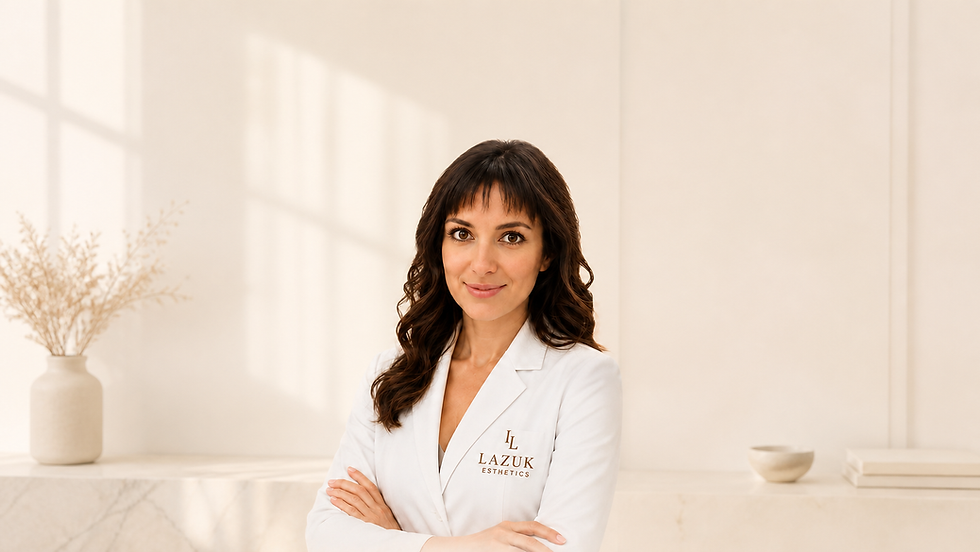
Dr. Iryna Lazuk is a board-trained dermatologist and the founder of Lazuk Esthetics® and Dr. Lazuk Cosmetics®, a physician-led medical aesthetics practice and dermatologist-formulated skincare line based in Alpharetta, Georgia. This article is intended for educational purposes and does not replace individualized medical advice. If you have specific skin concerns, please schedule a consultation.
Comments