Hottest Trends in K-Beauty 2026: What’s Really Defining the Next Era of Skincare

Updated: May 28

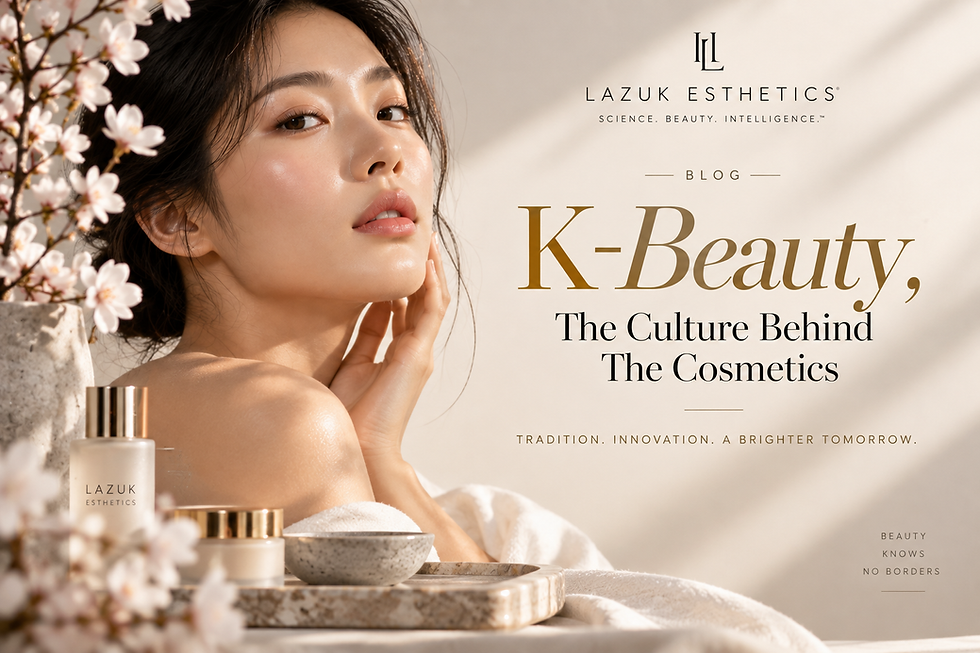
Hottest Trends in K-Beauty 2026: What’s Really Defining the Next Era of Skincare
There’s something magical about Korean beauty that keeps pulling the world forward year after year. It’s not just the dewy cheeks or glass-skin glow. It’s the way K-beauty always seems to know what our skin needs before the rest of us catch up. Whenever I travel to Seoul, I’m reminded that skincare isn’t a vanity ritual there—it’s a cultural rhythm. It’s community, innovation, wellness, heritage, and futurism wrapped into one smooth, perfectly hydrated face.
And 2026? Let me tell you… The new K-beauty wave feels different. It’s deeper. More scientific. More emotional. And, honestly, more human.
Think of 2026 as the year Korean beauty quietly says, “Move aside trends—let’s talk transformation.” As a dermatologist and a bit of a skincare futurist, I find this year’s innovations beautifully aligned with what our skin (and our lives) are craving: smarter routines, fewer irritants, more reparative ingredients, and a deeper relationship with the body’s own biology.
Allow me to walk you through the K-beauty breakthroughs shaping 2026, not in bullet points or technical fragments, but the way I would share it with a patient sitting in front of me—warm tea in hand, asking, “Dr. Lazuk, what’s next… and what should I really be paying attention to?”
Let’s dive in.
The Quiet Revolution: Biotech Becomes the New Beauty Currency
You’ve probably noticed the word biotechnology slipping into beauty conversations. It’s no longer niche—it’s the backbone of 2026 K-beauty. Korean labs are engineering ingredients that behave like your skin’s own molecules. Not similar. Not close. Identical.
This is not marketing fluff; it’s molecular mimicry at its finest.
One of the most breathtaking shifts is the rise of designer peptides—ultra-precise sequences created to send targeted messages to your skin. Imagine texting your collagen factory, saying: “Hey, love… can you work a bit smarter today?” And it does.
These aren’t the peptides of five years ago. Modern peptides are engineered for specific functions:
some calm inflammation at the cellular level
some trigger wound repair pathways
some fortify the barrier by mimicking the body’s natural lipids
some nudge elastin fibers to reorganize themselves
some “fill in” fine lines by improving extracellular volume
And because Korean formulations are famous for elegant textures, these ingredients don’t feel heavy or clinical—they melt into the skin like silk water.
Why does this matter today? Because we’re living in a chronically inflamed world—pollution, stress, processed foods, anxiety, the never-ending blue-light parade. Skin isn't just aging; it's also inflamed while aging. This new generation of peptides doesn’t just fight time… it fights the world we’re living in.
The Microbiome Isn’t a Trend Anymore—It’s Becoming the Core Identity of K-Beauty
There was a time the microbiome felt like a buzzword. But in 2026, K-beauty brands are treating it like the heart of the entire routine.
Here’s the secret no brand loves to admit: Barrier damage is the silent epidemic of modern skincare.
I see it in my practice every week—redness, dryness, flaking, unexpected breakouts, tightness, reactivity. And almost always… the root problem is an injured microbiome. 2026 K-beauty has shifted into probiotic-like complexes, fermented supermolecules, and bio-fermented hydrators that mimic what your microbiome would naturally produce if the world weren’t so harsh.
Korea has long loved fermented ingredients—but 2026 introduces a wave of next-gen ferments that are:
purified at the peptide level
filtered to remove irritants
stabilized for deeper penetration
tailored to specific skin concerns
One of my favorites? A new botanical ferment derived from mugwort and ginseng that’s showing remarkable results in soothing inflamed, acne-prone, and rosacea-prone skin. It doesn’t just “calm”—it whispers to overactive immune cells, telling them to slow down and breathe.
When the microbiome is happy, everything else glows.
Waterless Formulations: Korea Goes Ultra-Concentrated
I’ve already shared my enthusiasm for waterless skincare in previous posts—and 2026 K-beauty is amplifying this trend like never before. Traditional formulations use water as the base. Waterless formulas replace that base with:
botanical sap
floral distillates
fermented oils
plant mucilage
concentrated actives
Korea has mastered the art of turning a single product into a supercharged therapy. Instead of 70% water, formulas now feature 70% active plant compounds. It’s potency without the “five-step fatigue” that consumers are increasingly pushing back against.
But here’s the real breakthrough: Waterless products are aligning with Korea’s sustainability mission. Less water, lighter packaging, reduced carbon footprint, and more ethical production. And because they're ultra-concentrated, they last longer and penetrate deeper with fewer irritants.
This matters because consumers today want effectiveness without a heavy conscience. Skincare shouldn’t harm the planet—but it also shouldn’t underperform. Korea decided we no longer have to choose.
Exosomes Enter the Mass Market—But With Guardrails
Ah, yes… exosomes. My favorite little microscopic mail carriers.
K-beauty entered exosome science earlier than the West, but 2026 marks its first safe, regulated, dermatology-approved entry into mainstream skincare. Not the diluted, questionable exosomes you sometimes see floating around TikTok, but purified nano-vesicles from plant, marine, and probiotic sources.
These exosomes deliver:
peptides
growth-factor-like molecules
anti-inflammatory mediators
antioxidant complexes into the deeper layers of the epidermis.
But here’s the nuance: the best K-beauty brands clarified something essential—not all exosomes should be used daily. You’ll see “cycle-care schedules” emerging everywhere in Korea:
2 weeks on
1 week off
paired with barrier cycling
This strategic usage prevents overstimulation, because even good things can be “too much” for the skin’s natural rhythms. Overuse leads to inflammation, not rejuvenation.
In Korea, balance always wins.
Glass Skin Evolves Into “Bloom Skin”—The Next-Gen Glow
If glass skin defined the late 2010s and early 2020s, then 2026 will be remembered as the rise of bloom skin—a term that feels both poetic and biologically accurate.
Bloom skin is:
radiant but not shiny
hydrated but not greasy
bouncy but not plasticky
naturally even-toned without the “porcelain forced look”
It’s the glow of healthy capillaries, a fortified barrier, proper moisture retention, and a calm inflammatory response. Bloom skin is what happens when the inside (stress levels, hormones, hydration, diet, sleep) matches the outside (routine, actives, environment).
K-beauty’s 2026 bloom-skin formulas emphasize:
nano-hyaluronic acid
ceramide stacks
lipid-balancing toners
tranexamic acid micro-doses
antioxidant-based moisturizers
sleep-cycle repair creams
K-beauty is saying:No more mirror-chasing. Let’s rebuild skin that glows from its own health, not product layering.
AI-Matched Routine Personalization Hits the Mainstream
Korea is far ahead in AI adoption for skincare. In 2026, in-store and in-app technology can now read:
pore depth
sebaceous flow
melanin distribution
moisture reservoirs
micro-wrinkle density
sensitivity markers and create a fully customized routine instantly.
Imagine scanning your face, and an app tells you exactly which serums to pair with which moisturizers to avoid irritation while maximizing results. It even alerts you when your barrier is overloaded and advises you to “slow down your routine tonight.”
This is a huge step up from “take a selfie and guess.” AI is finally precise enough to help, not confuse.
For consumers overwhelmed by products, this is liberating.
For dermatologists like me, it means patients arrive with more realistic expectations—and healthier skin.
The “Skin Minimalism 2.0” Movement: Fewer Steps, Higher Science
K-beauty invented the 10-step routine, but 2026 Korea is rewriting the rules: It’s no longer about more products. It’s about smarter formulas.
Skin Minimalism 2.0 focuses on multifunctional hybrids:
toner-serum essences
peptide-moisturizer balms
exfoliating hydrators
microbiome-support cleansers
sunscreen-serum hybrids
Patients are tired, busy, stressed, and working harder than ever. They want radiant skin with fewer decisions. Korea listened. Minimalism 2.0 is not neglect — it’s optimization.
Botanical Neuromodulators: Korea’s New Anti-Stress Skin Technology
2026 K-beauty introduces something beautiful: neuro-soothing botanicals that affect the skin’s stress pathways. Not sedatives—but plants that speak the language of your nervous system.
Ingredients like Centella asiatica, ginseng, heartleaf, and snow mushroom are being re-engineered to reduce cortisol spikes in the skin. When emotional stress rises, cortisol damages collagen and barrier lipids. These new extracts temper that response.
It’s skincare that protects your complexion from your own life.
As someone who treats many patients with stress-triggered dermatitis, I cannot applaud this enough.
K-Beauty’s 2026 Big Lesson: Repair Before You Transform
Every Korean esthetician will tell you the same thing:“If the barrier isn’t healthy, nothing else matters.”
2026 is the year K-beauty embraces a “repair-first, correct-second” philosophy.
Patients today want quick fixes, but the skin doesn’t operate on trends—it operates on biology. K-beauty is reminding the world that slow, patient rebuilding is the fastest route to truly stunning skin.
And I wholeheartedly agree.
So… Who Benefits Most from These 2026 Trends?
Anyone struggling with:
inflammation
dullness
sensitivity
early aging
acne cycles
environmental fatigue
hormonal fluctuations
barrier damage will notice life-changing improvements.
But these innovations shine brightest for those ready to simplify, heal, and elevate their routine, not overwhelm it.
My Thoughts, From Dermatologist to Friend
K-beauty 2026 doesn’t feel like a trend report. It feels like a love letter to the skin.
It’s thoughtful. It’s emotionally intelligent. It’s scientifically precise. It’s compassionate. And it understands that beauty is not something we chase—it’s something we uncover when we support the skin the way it deserves.
What I love most is the return to balance. Korea is gently guiding the world away from harshness and toward harmony—between actives and rest, science and nature, transformation and patience.
If there’s one lesson 2026 K-beauty teaches us, it’s this: Your skin wants to bloom, not battle.
May your skin glow as brightly as your heart.
~ Dr. Lazuk
CEO & Co-Founder
Dr. Lazuk Esthetics® Cosmetics®
Would you consider biostimulatory injectables like Sculptra® or Radiesse® to strengthen and rejuvenate your skin from within?
Yes — I love the idea of long-lasting results
Maybe — I need to learn more
I’ve tried them already and loved the results
Not sure — I’m nervous about injectables
##KBeauty2026 #KBeautyTrends #KoreanSkincare #KoreanBeautyInnovation #BloomSkin #WaterlessSkincare #DesignerPeptides #BiotechBeauty #MicrobiomeSkincare #ExosomeSkincare #SkinMinimalism #KBeautyRoutines #SeoulBeautyTrends #GlassSkinEvolution #KoreaSkinTech #AdvancedSkincare2026 #DermatologistApproved #DrLazukEsthetics #AtlantaSkincare #JohnsCreekMedSpa #AlpharettaMedSpa #CummingMedSpa #GlowFromWithin #HealthySkinMovement #LuxurySkincare #FutureOfBeauty #SkincareScience #BarrierRepair #SkinHealth2026 #HolisticBeauty
If you're in Alpharetta, Johns Creek, or the North Atlanta area and want to experience Personalized Skincare with Dr. Lazuk, our team at Lazuk Esthetics® offers personalized, physician-led treatments tailored to your specific skin. Explore Personalized Skincare Protocols →
Comments